FEATURED POSTS
News

Jan 16, 2026
Yotta Labs Welcomes Jack Dongarra: A Signal for the Next Era of AI Infrastructure
Dr. Jack Dongarra, 2021 ACM A.M. Turing Award recipient and architect of modern performance benchmarking, has joined Yotta Labs as a Technical & Strategic Advisor. As AI infrastructure reaches a new inflection point, Yotta Labs is applying decades of hard-won HPC lessons to build an intelligent orchestration layer for scalable, interoperable GPU systems.
News

Jan 05, 2026
Academic Research Credit Support Program Launch
Artificial intelligence research is advancing at an unprecedented pace — yet access to scalable, reliable compute remains one of the biggest constraints facing researchers today. Across universities, research labs, and independent research communities, ambitious ideas are often slowed by limited GPU availability, high infrastructure costs, and rigid cloud environments not designed for experimentation. Researchers are forced to make tradeoffs: smaller models, fewer experiments, or long wait times for shared resources. At Yotta Labs, we believe infrastructure should enable discovery — not stand in its way. Today, we’re excited to announce the launch of the Yotta Labs Academic Research Support Program, an initiative designed to provide researchers with access to modern, production-grade AI infrastructure, backed by dedicated support and flexible pricing.
Research

Nov 12, 2025
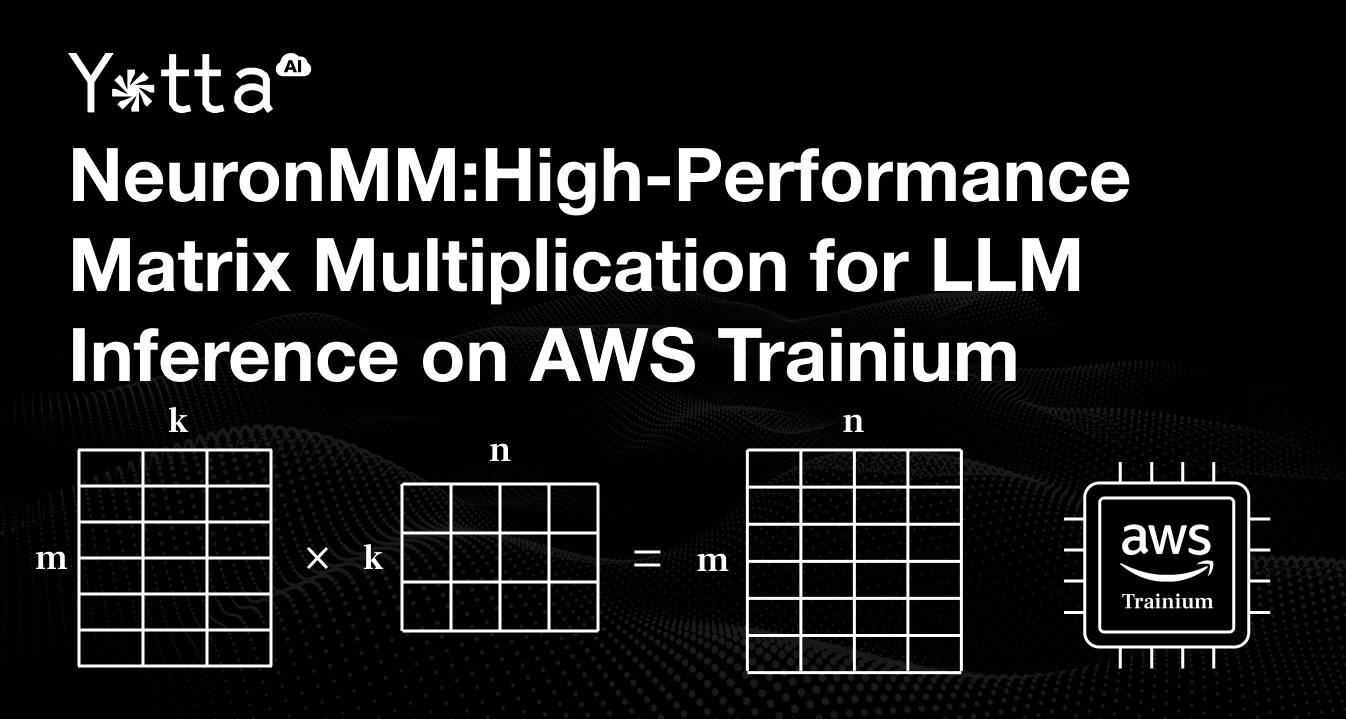
NeuronMM: High-Performance Matrix Multiplication for LLM Inference on AWS Trainium
Enabling high-performance of AI workloads on heterogeneous hardware is one of the major missions at Yotta Labs. Yotta Labs has explored various AI accelerators (such as NVIDIA GPU, AMD GPU, and AWS Trainium) to optimize performance and reduce production costs. Recently, our chief scientist Dong Li, leading a team of researchers, made significant breakthroughs in building high-performance matrix multiplication (matmul) for LLM inference on Trainium. Evaluating with nine datasets and four recent LLMs, we show that NeuronMM largely outperforms the state-of–the-art matmul implemented by AWS on Trainium: at the level of matmul kernel, NeuronMM achieves an average 1.35× speedup (up to 2.22×), which translates to an average 1.66× speedup (up to 2.49×) for end-to-end LLM inference. The code is released at https://github.com/PASAUCMerced/NeuronMM.
Research

Oct 23, 2025
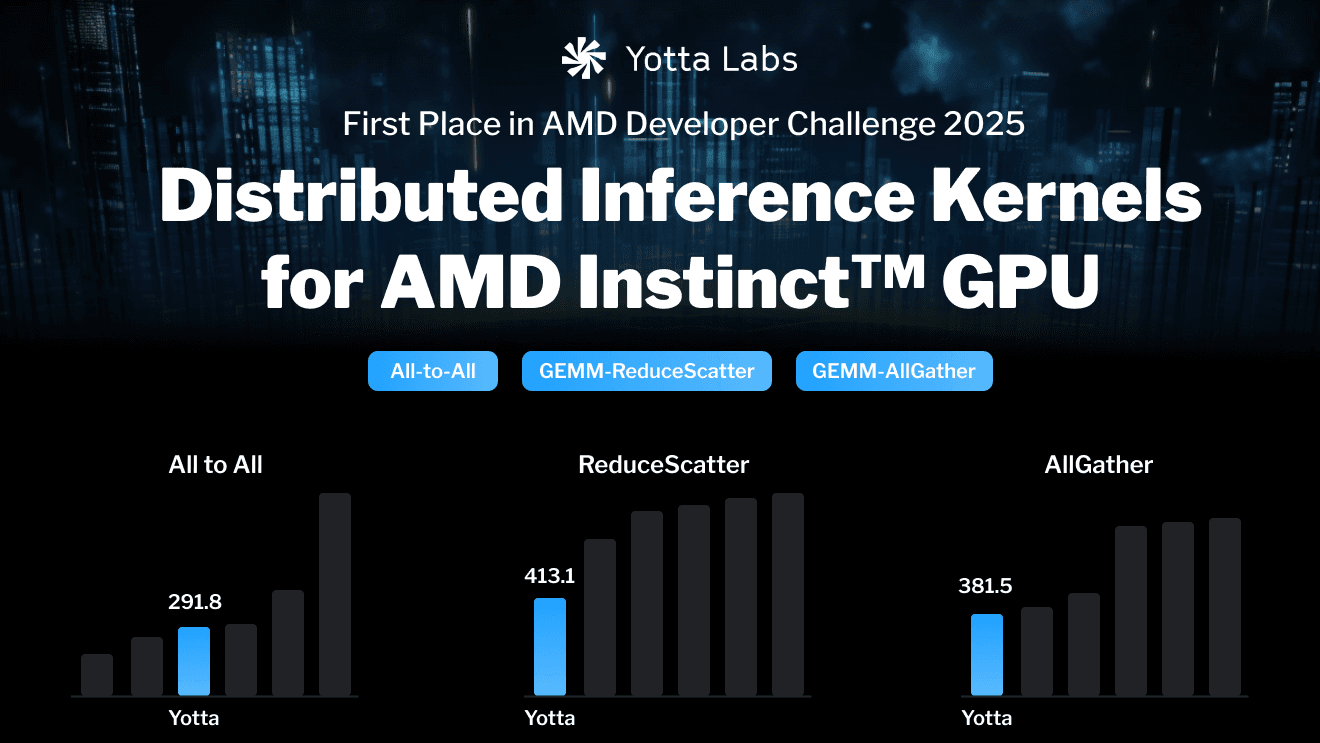
Optimizing Distributed Inference Kernels for AMD DEVELOPER CHALLENGE 2025: All-to-All, GEMM-ReduceScatter, and AllGather-GEMM
This technical report presents our optimization work for the AMD Developer Challenge 2025: Distributed Inference Kernels, where we develop high-performance implementations of three critical distributed GPU kernels for single-node 8× AMD MI300X configurations. We optimize All-to-All communication for Mixture-of-Experts (MoE) models, GEMM-ReduceScatter, and AllGather-GEMM kernels through fine-grained per-token synchronization, kernel fusion techniques, and hardware-aware optimizations that leverage MI300X's 8 XCD architecture. These optimizations demonstrate significant performance improvements through communication-computation overlap, reduced memory allocations, and ROCm-specific tuning, providing practical insights for developers working with distributed kernels on AMD GPUs.
Research

Oct 13, 2025
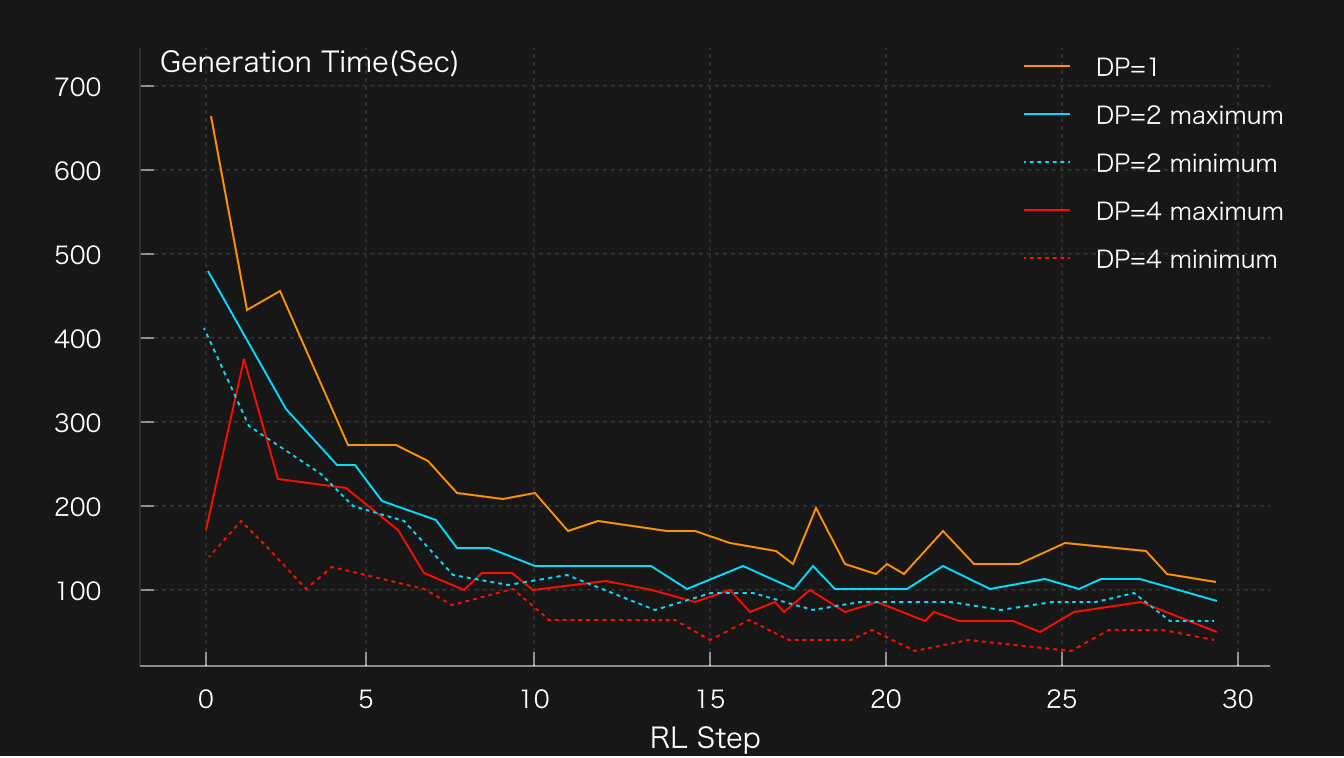
Performance Optimization for Reinforcement Learning on AMD GPUs
This blog presents our performance optimization and parameter tuning methodology for Reinforcement Learning (RL) workloads using the Verl framework on AMD’s MI300X GPU platform. By capitalizing on the MI300X’s 192GB of unified memory per GPU, we test and optimize the parallelism strategy to minimize the inter-GPU communication on the three phases in GPRO; we also explore the performance with various parallelisms and reveal the nontrivial relationship between the parallelism degree and performance.
News

Inference

Apr 09, 2026
Common Bottlenecks in LLM Inference at Scale (And How to Fix Them)
Scaling LLM inference is harder than it looks. This guide breaks down the most common bottlenecks teams face in production and how they improve performance, throughput, and cost.
Distributed Inference
GPU Pods
Inference

Apr 08, 2026
OpenClaw Alternatives: What Developers Are Actually Using Instead
OpenClaw helped push autonomous AI agents into the mainstream, but it’s not the only option. This guide breaks down the most relevant OpenClaw alternatives in 2026 and how they differ in real-world usage.
OpenClaw
Distributed Inference
Inference

Apr 07, 2026
How to Optimize LLM Inference for Throughput and Cost (Real Production Strategies)
Running LLMs in production is expensive and complex. This guide breaks down how teams actually optimize inference systems for higher throughput and lower cost, from batching and GPU selection to scaling strategies.
Cost Optimization
Distributed Inference
Inference

Apr 06, 2026
How LLM Inference Systems Actually Run in Production (Architecture Explained)
Most teams understand LLMs at a high level, but production inference systems are far more complex. This guide breaks down how real-world LLM inference works, from request handling to GPU execution and scaling across infrastructure.
Distributed Inference
Cost Optimization
Inference

Apr 03, 2026
Sora vs Runway vs Pika vs Kling: Which AI Video Model Is Best in 2026?
AI video is evolving fast, with models like Sora, Runway, Pika, and Kling leading the space. Here’s how they compare and how teams choose the right model for their use case.
Cost Optimization
Distributed Inference
Inference

Apr 03, 2026
Best Sora Alternatives in 2026 (And How to Avoid Getting Locked Into One Model)
Sora introduced a new level of AI video generation, but relying on a single model creates risk. Here are the best Sora alternatives and how teams build flexible video systems across models.
Cost Optimization
Distributed Inference
Inference

Apr 02, 2026
How to Use Multiple AI Models in One Application (Without Vendor Lock-In)
Modern AI applications don’t rely on a single model. Learn how teams use multiple AI models in one application to optimize cost, performance, and flexibility without increasing complexity.
Distributed Inference
Cost Optimization
Inference

Apr 01, 2026
OpenAI-Compatible APIs: How to Switch Models Without Changing Your Code
Switching AI models shouldn’t mean rebuilding your integration. This guide breaks down how OpenAI-compatible APIs let you use the same code while accessing multiple models, reducing friction and giving you more flexibility.
Cost Optimization
Distributed Inference
Inference

Apr 01, 2026
Best OpenAI API Alternatives in 2026 (Free, Open-Source, and Multi-Model Options)
Developers are exploring OpenAI alternatives to reduce costs, avoid vendor lock-in, and gain more flexibility. This guide breaks down what to look for and the best options in 2026.
Cost Optimization
Distributed Inference
Deep dives into multi-silicon AI optimization, infrastructure architecture, and the science behind Yotta's performance breakthroughs.