Apr 03, 2026
Sora vs Runway vs Pika vs Kling: Which AI Video Model Is Best in 2026?
Cost Optimization
Distributed Inference
Sora is discontinued, and Runway, Pika, and Kling are the field. How the four compare, and how teams stay flexible as the models keep changing.
AI video generation is moving quickly.
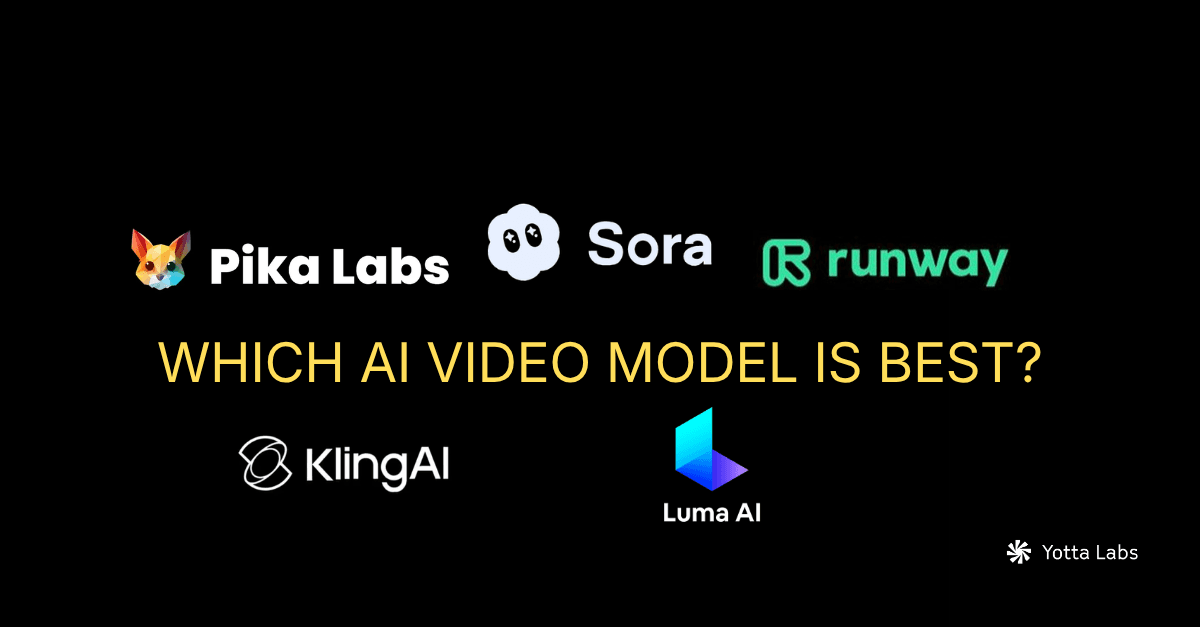
New models are being released at a rapid pace, each with different strengths, workflows, and levels of quality. Tools like Sora, Runway, Pika, and Kling are often compared, but there’s no single “best” option.
The right choice depends on what you’re trying to build.
The Challenge with Comparing AI Video Models
Most comparisons focus on features.
But in practice, teams care about:
- Output quality
- Speed
- Cost
- Ease of use
And most importantly:
How well a model fits into their workflow
If you’re exploring alternatives more broadly, we broke that down here.
Sora vs Runway vs Pika vs Kling at a Glance
| Model | Strength | Best For | Limitations |
| Sora | High realism | Cinematic video | Discontinued; API ends Sept 24, 2026 |
| Runway | Editing + workflows | Creators | Less control over realism |
| Pika | Speed | Quick iteration | Simpler outputs |
| Kling | Visual quality | Realistic motion | Still evolving |
Most teams don’t rely on just one of these models.
Sora
Sora set a new standard for AI video.
It demonstrated realistic motion, longer clips, and higher-quality outputs than many earlier models.
OpenAI has since discontinued it: the app and web experience shut down April 26, 2026, and the API follows on September 24, 2026. Treat Sora as the baseline everyone measures against, not an option you can pick
Runway
Runway is one of the most mature platforms in the space.
It combines AI video generation with editing tools, making it useful for creators and production workflows.
It’s often chosen for reliability and ease of use.
Pika
Pika focuses on simplicity and speed.
It allows users to quickly generate and iterate on videos without complex setup, making it a good choice for rapid experimentation.
Kling
Kling, now on Kling 3.0, has gained attention for high-quality visuals, realistic motion, and native dialogue audio.
It’s often compared to Sora in terms of output quality and is improving quickly.
How Teams Actually Choose Between Models
In practice, teams don’t just pick one model and stick with it.
They choose based on the task:
- High-quality cinematic output → Kling
- Fast iteration → Pika
- Workflow and editing → Runway
The “best” model depends on what you need at that moment.
The Bigger Problem: Switching Between Models
Even if you know which model to use, switching between them isn’t easy.
Each provider has:
- Different APIs
- Different formats
- Different integration requirements
This creates friction every time you want to test or adopt a new model.
If you want to understand how compatibility works, we covered that here.
A Better Approach: Multi-Model Video Systems
Instead of choosing one model, more teams are building systems that can work across multiple models.
This allows them to:
- Use the best model for each task
- Optimize for cost and performance
- Adapt as new models are released
Rather than locking into one provider, they build flexibility into the system.
Example: Yotta AI Gateway
One example of this approach is the Yotta AI Gateway.
It provides an OpenAI-compatible API that allows you to work across multiple models through a single interface.
Instead of managing each provider individually, you can:
- Route requests based on cost, speed, or quality
- Switch models without changing your code
- Handle failover if a provider becomes unavailable
This allows teams to build more flexible systems without increasing complexity.
Final Thoughts
AI video models will continue to evolve.
New models will improve, pricing will change, and performance will vary depending on the task.
The goal isn’t to pick one model and stick with it.
It’s to build systems that can adapt.