Mar 17, 2026
NemoClaw vs OpenClaw: Key Differences Explained
OpenClaw
Distributed Inference
NemoClaw and OpenClaw both enable autonomous AI agents, but they serve different roles. OpenClaw is built for experimentation, while NemoClaw adds security, control, and production-ready execution on top.
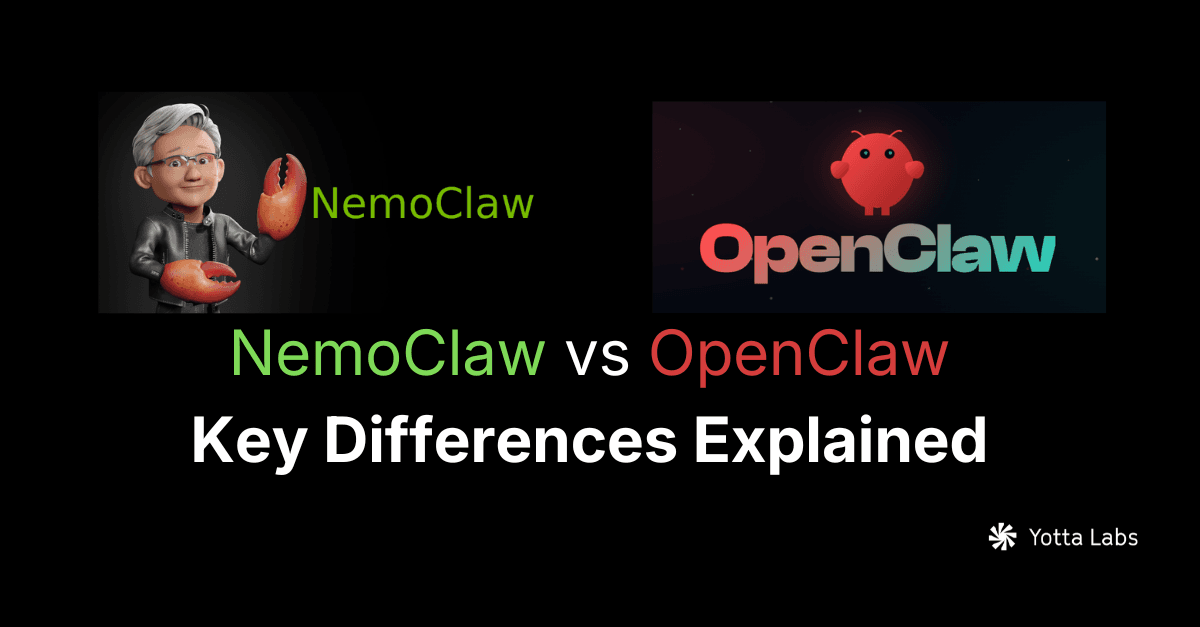
OpenClaw is an autonomous AI agent framework, while NemoClaw is an open-source stack from NVIDIA built on top of OpenClaw for running agents in production environments.
They are often compared because they solve a similar problem.
But they are built for different use cases.
In simple terms:
OpenClaw is designed for experimentation and local use.
NemoClaw is designed for controlled, production environments.
What is OpenClaw?
OpenClaw is an open-source autonomous AI agent framework.
It allows agents to:
- execute tasks
- connect to tools
- run multi-step workflows
- operate continuously
It is lightweight and easy to run locally.
This makes it useful for:
- testing agent behavior
- building prototypes
- experimenting with workflows
What is NemoClaw?
NemoClaw is an open-source stack from NVIDIA built on top of OpenClaw that adds security, control, and structured execution for running AI agents in real environments. If you want a deeper breakdown of how it works, see What is NemoClaw? NVIDIA’s AI Agent Platform Explained.
It focuses on:
- control
- security
- structured execution
Like OpenClaw, it supports autonomous agents.
It builds on OpenClaw by adding governance, policy controls, and production-grade reliability.
Key differences between NemoClaw and OpenClaw
1. Purpose
OpenClaw
- built for experimentation
- developer-focused
- optimized for flexibility
NemoClaw
- built for production use
- team and enterprise focused
- optimized for control and reliability
2. Execution model
Both platforms support persistent agents.
But how they manage execution is different.
OpenClaw
- agents run freely
- minimal restrictions
- flexible but less controlled
NemoClaw
- agents run within defined boundaries
- controlled execution environment
- policies define behavior
3. Security and control
This is one of the biggest differences.
OpenClaw
- limited built-in security controls
- relies on developer configuration
- higher risk in sensitive environments
NemoClaw
- policy-based control
- restricted access to systems and data
- designed for safer execution
4. Production readiness
OpenClaw
- suitable for local use and early-stage systems
- requires additional setup for production
NemoClaw
- designed with production in mind
- supports long-running services
- structured deployment approach
5. Infrastructure requirements
Both OpenClaw and NemoClaw orchestrate models rather than acting as models themselves.
This means infrastructure depends on the workload.
However:
OpenClaw
- easier to run locally
- can operate in simple environments
NemoClaw
- typically deployed in structured environments
- often uses containerized systems
- designed to integrate with production infrastructure
When should you use OpenClaw?
OpenClaw is a good choice if you want to:
- experiment with autonomous agents
- prototype workflows quickly
- run agents locally
- test integrations with tools and APIs
It is ideal for early-stage development.
When should you use NemoClaw?
NemoClaw is a better fit when you need:
- controlled execution of agents
- defined permissions and policies
- long-running production systems
- reliability and stability
It is designed for teams building real-world AI systems.
Why this comparison matters
The difference between NemoClaw and OpenClaw reflects a broader shift in AI.
We are moving from:
- simple model interactions
to:
- agent-based systems that run continuously
As this shift happens, the need for control and infrastructure increases.
OpenClaw shows what is possible. NemoClaw shows how those systems can be controlled and deployed safely at scale.
Final thoughts
NemoClaw and OpenClaw are not direct replacements for each other.
They represent different stages of the same idea.
- OpenClaw is focused on flexibility and experimentation
- NemoClaw is focused on structure and production use
Both are important depending on where you are in the development process.